Sunday, February 8, 2009

Jed Smith 50K: better start training

If you follow my blog, you know I'm way behind in terms of training. I have had shin splints since I resumed training beginning of January and, back then, did not think I had 6 weeks to waste going back in the hibernating mode of December. I initially stopped for 5 days, had two runs confirming the inflammation was not gone, then I stopped for 9 days which was still not enough as my Santa Cruz Badass run with Adam did prove. This time, I did not run for 14 days and it seemed an eternity as the inflammation disappears as soon as I don't run, so I never know if it is fixed for good or not.

After a business trip to Florida this past week, I showed up at Gibson Ranch Park in Elverta, without much training or basis (just 3 1-hour sessions on the bike over the past two weeks). To confirm that you had better train if you want to be competitive...

I car pooled on Saturday morning with Scott (Dunlap). Including the return trip, we spent over 4 hours chatting about running of course but even more about work, and parenthood too. Scott has amazing ideas about e-commerce, bringing the power of mobile computing and Internet to brick-and-mortar retailers, making such discussions fascinating and really entertaining. I had initially registered for the 50-mile but, given the injury, I decided to switch to the 50K. Furthermore, only the 50K counted for the USATF Grand Prix, so that made the decision a no brainer. Jed Smith Ultra Classic actually offers a third distance, a 30K (non ultra). the 50-mile starts at 8am, the 50K at 8:30 and the 30K 30 minutes later. These staged starts gave us the opportunity to see the start of the 50-mile and take pictures of all the runners after they completed their initial out-and-back mile before the 15 loops (see my Picasa photo album). Todd Braje took off and would keep the lead the whole way.
The 50K started right 30 minutes later. The heavy fog of the early morning was clearing up but it was still chilly. I kept my hat, gloves and long sleeves during the entire race, while others where just wearing singlets. I cannot wait for the heat training... As usual, Chikara took the lead in the first strides, like he was running a 10K. He was followed by Thomas Reiss. Thomas introduced himself on the starting line. Scott had told me in the car how fast he was (winning for instance the Tahoe Rim Trail 50-mile last year), and that he entered the Masters category last year. Thomas was going after the Masters age group course record today (3:18:03, 1996) and shooting for 3:15. That was way out of reach for me with my two goals for the day: first, finishing without worsening the injury and, second, potentially improving my PR of last year at Ruth Anderson (3:42) would my first goal be met.

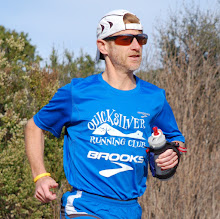
Despite these goals, I started on a faster-than-needed pace of 6:34 for the first two laps. After 10 miles, I started feeling the inflammation and slow down a bit. Then, to my surprise, I felt a cramp coming in my calf by mile 12. With nineteen miles to go, that did not seem right at all. The cramp eventually passed as I was working on my sodium but, by mile 21, both calves were torn out as I was going though the wall. I was so ashame of having to slow down to 8+ min/mile pace and got convinced Scott will catch me in the next three laps (Scott is the only runner I would never see on the course as we stayed within 5 minutes of each other all the time). That kept me jogging the whole way, even having to sprint when I finally saw Eduardo closing the gap in the last hundred yards. I finished in 3:51, almost 9 minutes slower than my PR, but finishing still, so meeting my first goal. I went for a very short run this morning to losen the calves up. The injury has not totally disappeared, but it is bearable. There is so much to do to prepare for the Napa Valley marathon in three weeks (my birthday run!), I may have to train through some pain. Photo courtesy of Michael's father:
Overall, with the 8-shape course, it was really special to keep seeing all the runners through out the day. Either crossing or passing, it gave many opportunities to share smiles, words or signs of encouragements, and feel the growing fatigue on others' faces, as we were logging the 3.3-mile laps (5, 9 or 15).
In addition to all the personal achievements, here are the ones which were the most amazing:
  • 1. Chikara Omine won the 50K in 3:08. That is a 6:03 min/mile pace or a 2:38 marathon on the way!
  • 2. Todd Braje won the 50-mile in 5:30. That corresponds to an average 6:36 min/mile pace or two 2:53 marathons back to back! After his 3:30 win at Way Too Cool 2008, his win at Helen Klein, we are going to see Todd on a lot of podiums this year. Unless he gets caught in the US 100K Team regimen, which would impose a limited number of international races.
  • 3. Last but not least, our local Ultraholic, Michael Kanning completed the 50 miles in 6:23, taking third overall, just 4 minutes behind Sean Meissner. At only 17, Michael improved his Helen Klein PR my more than 26 minutes and came short of 7:29 minutes of Karsten Schulz' US 50-mile trail record set in 1977 at JFK (which raises the issue of trail comparison, Jed Smith being almost flat while JFK has some quite technical sections from what I have seen on the Appalachian Trail). Anyway, this is an amazing performance and I was proud to see Michael holding the pace for so long after some missfortune last year. This is extremely promising and it will be exciting to see Michael focusing on road racing this year. By the way, like me, Michael is a Brooks ID'er (Inspire Daily program) and a Brooks aficionado!
Todd, with one more lap to go:
Michael (and his father on the left), with 2 more laps to go:
With this loop format, it was great to see the runners keeping going through the finish line area and aid station, giving them some words of encouragements, especially after having experienced some pain on the course ourselves. It was nice to see Greg Soderlund at the finish. Looking at runners getting to the finish, he seems like a NCAA coach and recruiter, looking for the next star to get on Western States... See my Picasa album for a few pictures of the finish line area.

Although I carried my Gu2O bottle the whole way (sorry, don't like Gatorade!), it was very convenient to have two aid stations on the course, one every 1.5 mile. A big thank you to Dennis, the Race Director, to the Buffalo Chips running club for setting up such a professional event (including ChampionChip timing!), to the volunteers at the aid station, and a special thank to the volunteer who stationned for hours at the entrance of the second loop and provided personal encouragements (we saw him 18 times on the 50K!). Apart from the chilly temperatures at the start, the loop format made it very easy for the crew, some bringing comforting support as you can see!
A great event overall, which I strongly recommend to people looking at their first ultra as this provides a nice setting to get support, as well as a nice transition from road racing, with a convenient mix of pavement and flat trail. And of course to the ones looking at a PR, except for the fact that this is the first official race of the season, so it's easy to show up untrained. Like me yesterday...

By the way, I missed Jed Smith last year because of my participation to The Coastal Challenge in Coasta Rica. I was looking forward to tracking the race on the web last week, especially to see what Scott Jurek was up to but, unfortunately, not a single update has been posted on the TCC website. I hope they are OK and that is just due to the lack of connectivity in the rain forest. Actually, I finally found the updated site ("another" official site). Results: defending 2008 champion, Javier Moreno from Coasta Rica, won again this year. He was followed by David James (3rd last year - I finished second, in debt of David who pulled me out of a creek in the 5th stage). And Scott Jurek placed third. I look very much forward to hearing Scott's recount of this adventure on his blog (check his last post about hibernating - This -hibernating- I feel I've done well in December but maybe one month was not enough...).

Sunday, February 1, 2009

LDR 2008 Awards: Tim Twietmeyer and other champions in the spotlight

LDR stands for Long Distance Running and was the theme of this Saturday Awards Banquet hosted by the Tamalpa Runners in San Rafael. The party was held at The Club, the restaurant of the McInnis Park Golf Center. I drove up there with Bill Dodson, a club mate from the Stevens Creek Striders, and his daughter, Estelle. The 120-mile round-trip was a good opportunity to get to know Bill better and discuss our respective plans for the 2009 season. We left South Bay just before dawn. The sky was so clear, we could enjoy views tens miles away from the scenic Highway 280. And thousands of stars on the way back.
Hats down to the Tamalpa Runners for hosting a perfect event, from the very professional setting (audio and video), neat dinner, outstanding guest speakers, a detailed program, special awards, to a thoughtful recognition of the many champions of the 2008 racing season.
The first speaker was Dan Bowden, the first American to break 4 minutes (3:58.7 precisely) on the mile, at Cal (Berkeley) on June 1, 1957 (see this interesting article and interview of Dan on Recordnet.com by Paula Parrish). We first looked at a USATF video retracing Dan's quest toward this symbolic milestone. Then, in front of a captivated audience, Dan shared many personal notes and memories of the years leading and following this key achievement. Although the theme of the evening was long distance running, we could all very much relate to the feelings expressed by Dan, from the difficulties of training so hard during his College years to the happy moments he shared about his coach, team mates, opponents. In addition to Dan's wife, several others in the audience had followed these events in the fifties as you could see from the nods.
The second illustrious guest speaker was much more from the LDR world with his 25 Western States runs, including 5 overall wins and 15 consecutive top-5 finishes: Tim Twietmeyer! Although LDR covers short and long distance road races, cross country and ultra trail and mountain running, about half the audience had run at least one ultra, so the ultra was heavily represented and eager to learn from Tim. Tim was interviewed by the local elite trail runner, Greg Nacco. And Greg excelled at the exercise, maximizing the use of his 30-minute slot to get Tim to share a variety of anecdotes and tips, in a Saturday-Night-Show way! I am not going to attempt to give you a full transcript, only a video would convey the liveliness of this interview. However, for those who could not make it, see at the bottom of the post some of the key take-aways from my notes.

After such enlightening presentations, it was time to turn to the less known local champions, the winners of the 2008 Race Season. No less than 76 trophies were awarded, from individual runner, volunteer and team awards, in 4 race categories (short and long road racing, cross country and ultra running), men and women, and up to 6 age groups now that Sam Hirabayashi (Tamalpa) has is own Super Veteran category! Nevertheless, despite this long list of names, our PA USATF LDR committee did a wonderful job at keeping a good pace while providing ample and personal words of recognition to most of us.

On the Road Racing and Cross Country side, the ones whom I found the most impressive among the awardees in the audience were:
  • Brian Pilcher, from Tamalpa, National Senior (50+) Cross-Country champion;
  • Russ Kiernan, also from Tamalpa, who won three out of three catageroy awards!
  • Bill Dunn, from West Valley Joggers and Striders, who brought home 4 individual awards and 3 for his club!
Bill was at our table and, before leaving, told Bill (Dodson) and I he was one of the co-founders of our club, the Striders, in the early 80s.

On the Ultra Running side, here are 5 of the 6 age group champions, from left to right: Bill Dodson (Stevens Creek Striders, Veteran, 70 and above), Joseph Swenson (unattached, Senior, 50+), Jean Pommier (yes, I, Stevens Creek Striders, Masters), Eduardo Varquez (Pamakids, Senior Open) and Jason Reed (NB Excelsior, Open), and in the background on the far left, Ken Grebenstein, the President of the Tamalpa Runners, the hosting club:
Last year, in addition to winning my age group, I was awarded the coveted title of "Pacific Association Ultra Runner of the Year", for my first year in ultra and my focus on the PA MUT Grand Prix. I was proud to be nominee again this year but glad that Eric Skaden got the award this year, much deserved on the basis of the very impressive achievements at Tahoe Rim Trail 100-mile (overall win), Miwok and American River. Incidentally, Eric took first in last year's Montrail Cup and I took second.

Bev (Anderson-Abbs) took home the PA Ultra Runner of the Year too. Here she is with her husband, Alan (right) and our dear and dedicated LDR MUT Commissionner, Hollis Lenderking.
The second pillar of our MUT Grand Prix, Gary Wang (Tamalpa), and no less dedicated volunteer, received the 2008 Service Award for Ultra Running. He was all smile:
Again, congratulations to the Tamalpa Runners for a perfectly run event, and great awards! THANK YOU, and see you on the trails for some sane competition!


A summary and brief transcript of Tim Twietmeyer's interview by Greg Nacco. (I've inserted a few pictures of Western States at Last Chance, from the times I was the Captain of this aid station, on behalf of the Sriders who have been manning it for 27 years in a row!)
Greg kicked off the interview by counting one of his run of the 80s, SilverState, during which Tim saved him by lending him his gloves while they were running through the blizzard.
Greg: When and how did you get into running?
Tim: In high school I was playing competitive golf, when the youngest of my three oldest sisters started running. I felt I had to do to and started running too. I lived in Woodside then and, during my Junior and Senior years, I found out about a 24-hr event at Woodside School Track (read about it on the back cover of Runner's World at the library). Was amazed to see runners like Dick Collins, Ruth Anderson, Big John, Don Choi (the pionneer of the modern 6-day races), running laps and putting in more than 100 miles. Then I heard about Western States, applied, ran my first 50-miler at this track event in 1979, went on the course and, after seeing the canyons, decided WSER wasn't for me, yet.

Greg: When did you run your first 100-miler then?
Tim: One year later, in 1980, I went back to the Woodside track and ran 100 miles in 21 hours and change.

Greg: We heard about Dan on the mile, what about you on shorter distances?
Tim: I'm not that fast (laugh)! My PRs are about 17:30 on 5K, around 37' on 10K, 2:36 and change on marathon. And for the mile? Never ran under 5'.

From the audience: What were your first times at Western States?
Tim: 22:04 the first year and 22:53 the second. Felt great the first year, miserable the second. I got sick and, as I was recovering toward the end of the race, it was the turn for my dad who was pacing me. It ended up to be a miserable experience for both of us!

Greg: Speaking of pacer, ever dropped one in a race?
Tim: Well, yes... twice actually. The first time was at WS in 1985. A tough one, a snow year (snow on the first 20 miles) yet with high temperatures in the 105-106F. I was in the lead at the river with 20 miles to go when I heard people cheering a runner on my heels. That was Ann Trason, in second. My pacer wasn't going well, as opposed to Ann's pacer, Frank Ruona (author's note: who just happened to be sitting next to me at dinner!).

Greg: Can you think of a perfect race?
Tim: I would elect the year I broke the Masters course record. In retrospect, you always wonder, after a race, what you could have done differently. On this one, I could not find anything. I remember having taken salt at the right time, before getting potentially dehydrated.

Greg: You've proven yourself on Western States, what's your next challenge?
Tim: yes, I'm semi-retired from Western States (author's note: does the semi imply a come back à la Lance Armstrong on Tour de France, or Scott Jurek at WSER next June?? A come back to set the 50-59 course record?). When you are in your mid-forties, you realize that you are not getting faster. I'm thinking of some adventure racing, or runs in stages, from one point to another. I've been pretty much focusing on Western States for 25 years, so I would also like to try new events.

Tim enjoying Dick's "car wash" at Last Chance, WS '06 (with Tom Kaisersatt in the background):
Greg: Favorite training run?
Tim: yes, a very specific one: go on the Western States course, start from mile 70 back to mile 45 (Swinging Bridge). Take a swim, then come back. Stop at Foresthill (mile 62) and enjoy an ice cream sandwich and mountain view, then hammer down the last 8 miles. We call this run the "ice cream sandwich run!" Leaving Foresthill strong is what separates the top runners from the rest.

Greg: Any tip about pacers and crew?
Tim: The best is to have folks entertaining, positive, making good jokes. When you are on the trails for a day, and you know that it's going to be a couple of hours before you see your crew again, you need people you can rely on to get re-energized very quickly at aid stations. It's like plugging in to get your battery recharged and pulling the plug until the next stop. Your crew has to know you well, what you eat and drink in races.

Greg: You are known for wearing headphones, what are you listening to?
Tim: it varies from rather cool music (country) early in the race, to hard rock such as AC/DC toward the end!

Greg: Tips on fueling during a 100-miler?
Tim: clearly, the most important idea to keep in mind is that, the more you go, the less you can eat. So you have to take a lot of calories in the first part, which you will use in the second half. At the end, it's a lot about sugar and caffeine, M&M's, soup.

At Last Chance, WS '05, photo courtesy of Kiran:
Greg: You are a big sport fan, what is your favorite team?
Tim: These days, my top of the list team is the San Jose Sharks. I love watching hockey. Amazing how every team member is playing, in a constant rotation or shift between the bench and the ice.

Greg: Do you practice another sport?
Tim: I tend to do more cycling now, which provides great cross-training while reducing the impact. I was telling Gary that, eventually, I will go back to swimming at some point, making the full circle, closing the loop.

From the audience: How are your knees?
Tim: so far so good! And cycling for cross-training helps.

Greg: Who are you rooting for in the Super Bowl?
Tim: St Louis! I mean Arizona, they have a good chance to win this year.

Greg: How do you balance work, family and running?
Tim: This is really something I don't know much about. I have always been running a lot, at least one hour a day, most of the days since high school, so it has always been part of my adult life, and part of our family life.

From the audience: Did you run into snakes?
Tim: Spending thousands of hours on the trails out there, I certainly saw bears and snakes, but never a mountain lion. Snakes are particularly dangerous as they emerge at the first hot days in the season, and they are really hungry, loaded with venom...

From the audience: What about tips on the mental side?
Tim: Indeed, mental is essential to do well in competitive running. I started realizing it when I had a disappointing 50K road race after the birth of our second child (who had some handicap). I knew I could have done much better, but I had thousands of thoughts juggling in my mind. After that, I started doing much more analysis of races, like chopping the Western States course in small pieces, knowing them perfectly to the point that I could visualize how I will be on each of them on race day. To the point I was right on where I wanted to be on race day. (Author's note: similarly to Dan's remark, that he knew to the tenth of second his split without having to look at a stop watch.)

Tim looking strong as he is leaving Last Chance (mile 43) at WS '06:
Greg: Any last tip to conclude?
Tim: Yes, to do well at Western States, you have to hammer down the downhills. These are sections were you don't use much energy and the downhills is what makes a big difference among the top runners on this course. You need to push as much as running them at your half-marathon pace.

Way Too Cool start, March 2007: