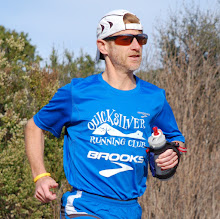
Running in general, and ultra running in particular, are so experimental... Sure, there is the famous adage 'listen to your body' but, sincerely, if you want to push to the limit and progress, it's quite difficult to discern which size of the limit you are flirting with...
As you read last week, and with two more workouts at the track this week, this has been a serious 'back on track' month for me. Not only 'back at/to the track' but also a pleasure to enjoy some speed again. However, that reminds me so much of last year, and the previous years as a matter of fact, it's like pacing myself in a long ultra, I need to make sure I'm not getting too excited and ahead of myself, or rather ahead of my shape/form...
On Tuesday, I met Bob and Jeremy again and the speed work out consisted of 6 x 800m. We hit 2'40" twice, it has been a while since I ran 2 laps at 5:20 min/mile. But I skipped Thursday as I didn't feel like pushing more at the track this week. But the real reason is that, since last week, I could feel something high along my right tibia, a good signal to remind me that the track is actually a tough surface to train on.
Indeed, as much as I highlighted great properties for and from training at the track, people think that the rubberized surface must be very soft and easy on the joint, but that's actually the opposite. Because it is meant to increase traction, it is unforgiving for all the small (or big...) defaults we have in our strides since the sole pretty much stick to the track as soon as you apply pressure. Unless dirt on which your shoe can slide to make any correction. Moreover, a trail has many defaults which makes each stride different, as opposed to a smooth rack.
With that, I went to Alviso on Friday to run the 9-mile loop of soft dirt twice. Sure enough, I didn't feel any pain in my leg so, what did I do on Saturday... go back to the track for more! I initially wanted to run at least 26 miles so started at a more conservative pace than last week (1'45" laps or ~7 min/mile) but, after 10 miles, I wasn't so comfortable and thought I was going to run 'only' 64 laps (16 miles) instead. I managed to go beyond this, even picking up the pace in the last 2 miles, for a total of 20 miles again. But, this Sunday, the pain was back and I cut my run short at 10K to play safe.
Nothing too serious I think, and it's a good time to taper before Jed Smith 50K next Saturday anyway, but a good 'listen to your body' experience after a 334-mile month at an average of 7:15 min/mile, albeit mostly on flat terrain.
Back to the title, it is so challenging to dose our training appropriately: too much and you break then lose a lot of time having to recover and get back in shape, too little and you won't progress much or won't even know if you could have done better. Besides, all this becomes trickier as we age (less resistance before breaking and more time to recover if ever...). Keep it up as they say...! ;-)
While sometimes I'd love that training and performance followed some mathematical and predictable laws, it wouldn't be as interesting and motivating to explore our capability or to know that you reached an horizontal asymptote or, worse, a declining one, would it be?
The good news is that, in addition to attentively listening to our body, we can learn from what people share (blogsphere, Facebook, magazines, Strava, ...), and get advice, motivation, encouragement and/or reason from listening to others. Also, we have this amazing ability to (re)train our body and push the red zone further, as long as it is progressive.
Interested in hearing about your own experience. Which signs do you see, or feel, before a potential injury? What do you consider too much? Which strategy did you use to raise your own limits? How do you know you are close to your body limits while not going over the wrong side? Big but non philosophical ultra running questions to kick off this longer-than-usual month of February...
Sunday, January 31, 2016
Saturday, January 23, 2016
The discipline of the track: essential training component
It's not a scoop, but it is worth the reminder, speed workouts at the track don't seem natural to the ultra and trail runner, yet they are essential to a complete training and, of course, to build up form and speed.
(Picture taken from an article with great speed workout tips from champion Alan Culpepper in RunNow.eu)
The first benefit of the track is the precise measurement of distance which allows for a precise pacing. As much as the GPS watches made progress these years, they are typically a few percent off, especially on hilly trails. And, on uneven trails, you are never at a constant pace.
The second benefit of training at the track is that it invites you to focus on intensity on much shorter distances than usual. I typically don't do anything shorter than a lap (400m or 440 yards), but speed work can include explosive hundreds or 200s.
The third element of track workouts is the complete flatness which allows you to focus on your stride.
Last but not least, the best is to do these workouts with some company, buddies running at your max pace (e.g. 5K race pace) or slightly faster so you get a challenge. Meeting others will also increase your chance of completing these work outs and including them in your busy life schedule.
We are so lucky in the US with so many public High Schools and Colleges having state of the art tracks open to the public every day, at least outside of school hours and between dawn and dusk. And even more lucky in California in particular where the weather cooperates all year round (I'm sorry for those leaving on the East Coast for instance as most tracks must be under 1 or 2 feet of snow as I write this post). That's a luxury which appreciate even more as I travel around the world.
During the full season, I race and travel so much that I've hard time doing track workouts regularly. After 2 weeks overseas this month, it was a delight to be able to get to the track with my buddies Jeremy and Bob on Thursday. We do all sort of work outs there, ranging from standard repeats from 12x400s to 3 miles, or the more complicated pyramid: 400-800-1200-1200-800-400 and breath-recovery breaks of 20 to 30" per lap completed (it is important to keep the cadence going to remain in an anaerobic state to get the full benefit of the workout). As you see, our sessions always consist in 3 miles of intense work which we do after 2 miles of warm-up (and catching up on work, family and other National or World news), and followed by a 1-mile cool down jog plus some stretching before getting back to work. When we can, we meet on Tuesdays and/or Thursdays at 5:45 am at Mountain View High School which is one rare campus leaving the access to the track open most of the time (exceptional closure for instance when they prepare the field for graduation in June).
This Thursday, Jeremy picked an unusual workout called the washing-machine: 12 x 400s, alternating the rotation direction each time and walking 100 meters to the start of the next lap (in other words, first starting at the usual starting line, then at the 300-meter mark in the opposite direction). We clocked laps between 82 and 75 seconds. I was just done with a 202-kilometer training week (the 3 50Ks I mentioned in my previous post, one every other day), I could barely keep up with Jeremy and Bob this time and would have never pushed that hard if not with/for them!
After taking Friday off (yes, rest is important and I used to be much better with taking a day or 2 off each week, years ago), I was back to the track this Saturday morning, albeit another one, at Cupertino High School. For a much different work out, a (very) long tempo run. This time, my goal was to run 20 miles at a sub 6:30 min/mile pace. Yes, that's 80 laps, and I'm glad my Garmin GPS has a function to keep track of the laps and lap times. With one time every lap, it's like a super slow motion metronome, yet much better from a pacing standpoint to one measurement every mile.
Sorry for the purists, but I'm counting 4 laps to the mile although this is missing about 10 meters, that is less than 1% error.
Anyway, I started with slightly faster laps (of course!), in the 1'32"-1'34" range but I'm glad to report that I was able to keep up that pace most of the way, averaging 6:20 min/mile pace for these 80 laps, with my fastest lap at 1:32 and slowest at 1:37. Not to bad for a metronome, especially given a few bursts of wind in the first hour and some rain in the last 12 laps. Great training to build up conditioning before the racing starts in 2 weeks.
I hope I gave you some motivation to hit the track at least once in a while. If you want to run faster, you cannot escape this track regimen, this is what will have the most impact and make the most difference in your training miles. Even for trail races, just look at how fast the young elite runners are!
Many happy laps to all then!
PS: for those in the South Bay, it has been a while I didn't visit these tracks, but I recall Los Gatos High School being also quite welcoming, as well as De Anza College (I imagine the same for the nearby Foothill College). The tracks of the Cupertino High School District, which have all been renovated recently (Cupertino High, Homestead, Fremont, Monta Vista) have high fences and strict closure hours at night unfortunately. If you know of other welcoming/all-time open tracks, thanks for leaving a comment underneath.
(Picture taken from an article with great speed workout tips from champion Alan Culpepper in RunNow.eu)
The first benefit of the track is the precise measurement of distance which allows for a precise pacing. As much as the GPS watches made progress these years, they are typically a few percent off, especially on hilly trails. And, on uneven trails, you are never at a constant pace.
The second benefit of training at the track is that it invites you to focus on intensity on much shorter distances than usual. I typically don't do anything shorter than a lap (400m or 440 yards), but speed work can include explosive hundreds or 200s.
The third element of track workouts is the complete flatness which allows you to focus on your stride.
Last but not least, the best is to do these workouts with some company, buddies running at your max pace (e.g. 5K race pace) or slightly faster so you get a challenge. Meeting others will also increase your chance of completing these work outs and including them in your busy life schedule.
We are so lucky in the US with so many public High Schools and Colleges having state of the art tracks open to the public every day, at least outside of school hours and between dawn and dusk. And even more lucky in California in particular where the weather cooperates all year round (I'm sorry for those leaving on the East Coast for instance as most tracks must be under 1 or 2 feet of snow as I write this post). That's a luxury which appreciate even more as I travel around the world.
During the full season, I race and travel so much that I've hard time doing track workouts regularly. After 2 weeks overseas this month, it was a delight to be able to get to the track with my buddies Jeremy and Bob on Thursday. We do all sort of work outs there, ranging from standard repeats from 12x400s to 3 miles, or the more complicated pyramid: 400-800-1200-1200-800-400 and breath-recovery breaks of 20 to 30" per lap completed (it is important to keep the cadence going to remain in an anaerobic state to get the full benefit of the workout). As you see, our sessions always consist in 3 miles of intense work which we do after 2 miles of warm-up (and catching up on work, family and other National or World news), and followed by a 1-mile cool down jog plus some stretching before getting back to work. When we can, we meet on Tuesdays and/or Thursdays at 5:45 am at Mountain View High School which is one rare campus leaving the access to the track open most of the time (exceptional closure for instance when they prepare the field for graduation in June).
This Thursday, Jeremy picked an unusual workout called the washing-machine: 12 x 400s, alternating the rotation direction each time and walking 100 meters to the start of the next lap (in other words, first starting at the usual starting line, then at the 300-meter mark in the opposite direction). We clocked laps between 82 and 75 seconds. I was just done with a 202-kilometer training week (the 3 50Ks I mentioned in my previous post, one every other day), I could barely keep up with Jeremy and Bob this time and would have never pushed that hard if not with/for them!
After taking Friday off (yes, rest is important and I used to be much better with taking a day or 2 off each week, years ago), I was back to the track this Saturday morning, albeit another one, at Cupertino High School. For a much different work out, a (very) long tempo run. This time, my goal was to run 20 miles at a sub 6:30 min/mile pace. Yes, that's 80 laps, and I'm glad my Garmin GPS has a function to keep track of the laps and lap times. With one time every lap, it's like a super slow motion metronome, yet much better from a pacing standpoint to one measurement every mile.
Sorry for the purists, but I'm counting 4 laps to the mile although this is missing about 10 meters, that is less than 1% error.
Anyway, I started with slightly faster laps (of course!), in the 1'32"-1'34" range but I'm glad to report that I was able to keep up that pace most of the way, averaging 6:20 min/mile pace for these 80 laps, with my fastest lap at 1:32 and slowest at 1:37. Not to bad for a metronome, especially given a few bursts of wind in the first hour and some rain in the last 12 laps. Great training to build up conditioning before the racing starts in 2 weeks.
I hope I gave you some motivation to hit the track at least once in a while. If you want to run faster, you cannot escape this track regimen, this is what will have the most impact and make the most difference in your training miles. Even for trail races, just look at how fast the young elite runners are!
Many happy laps to all then!
PS: for those in the South Bay, it has been a while I didn't visit these tracks, but I recall Los Gatos High School being also quite welcoming, as well as De Anza College (I imagine the same for the nearby Foothill College). The tracks of the Cupertino High School District, which have all been renovated recently (Cupertino High, Homestead, Fremont, Monta Vista) have high fences and strict closure hours at night unfortunately. If you know of other welcoming/all-time open tracks, thanks for leaving a comment underneath.
Labels:
Training
Subscribe to:
Posts (Atom)