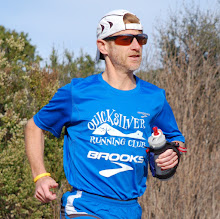
Miwok. A strange name which has its roots in the Native American culture. The name of the people who were living in North California and were speaking the Miwokan languages. The name of a trail in the Marin Headlands. A legendary name in the ultra community, at least in the US and on the West Coast. And, with fame comes issues getting in nowadays, with too many candidates for too few spots, even if we were more than 300 starters this year. As you might recall from one my of January posts, it took a lot of planning and "cyber celerity" to get into the 2008 editions. Rumors circulate that Miwok is going to turn to a lottery system next year. The same year as Western States will change its lottery rules to address the overwhelming demand and limitations of the lottery system itself, challenge by the increasing number of the two-time losers (up to now, the ones who did not get pick from the hat two years were automatically in the third year, upon still meeting qualifying standards then).
Miwok. A hilly and challenging 100K, in an incredibly nice and protected area, the Marin Headlands, a National Recreational Area just a few miles North of San Francisco and part of the Golden Gate biosphere, created by UNESCO. A tough course which leads some to call it "me, walk" as even some downhills are tough to run. Mathematically the distance of 2.4 marathons, but much more with almost +/- 10,000 feet of elevation.
My first Miwok turned to a bad experience because of asthma kicking in before the first 20 miles, and a lot of walking to get over all the uphills, ending up in a disappointing (for me) 10:53 time. With all the walking, and despite the incredible boost I got from Bob (Evans) who paced me in 2007, I had not only good hope to improve this year but put a great time, shooting for around 9:15.
The day started really early, waking up at 2:30 to get some breakfast and drive to Palo Alto to Craig's place. Craig is a member of our mid-Peninsula Saturday morning ultra running group and his sister, Lisa, was volunteering at Pan Toll.
 Other members of this car pool crew were Mike (also working at SRI with Craig) and Charles, whom we picked on the way, in San Francisco (Mike, Charles, Craig and I, photo credit Craig/Lisa Heinselman).
 With 4 runners on board and a volunteer, we received the VIP treatment and were able to park next to the drop bag areas and 10 yards from the registration table. At 4:20 am we were among the first runners to check in and the opportunity to talk to Stan (Jensen) and Tia (Bodington) before the rush. A rush which actually happened later this year because of the new parking rule and the checkpoint sorting out vehicles and routing non car poolers to a remote parking. This delay got us to start just before 6 am instead of 5:45, giving us daylight for the sandy leg on the beach.
Chatted with Scott Jurek walking to the starting line, telling him I had put my (virtual) money on him on Karl (Meltzer)'s betting blog post. And introduced to him Eric, another Brooks ID'er, whom I'd met at American River. Stood at the starting line next to Hal Korner, last year Western States winner, and Bev (Abbs-Anderson) and Kami (Semick) the two favorites on the gals side (with Devon not making it from the waiting to the final entrants list).
I was resolute to start slow this time, to preserve my lungs in this cool and early morning. In the first hill, I caught-up with Mark (Tanaka) who was telling Kami all about his issue getting to the start line because of a Southbound-101 detour. I'm always amazed how Mark can keep talking while going uphill. On my side, I was not really up getting on the conversation, to save my lungs. Quickly we reached Bev and Mark seemed to entertain both of them now. On my side, I passed Simon (Mtuy) who had an issue with his shoe. Simon just arrived from Tanzania 2 days ago, for two months of ultra racing in the area, culminating with Western States. He passed me around mile 30 last year when I was struggling, and I thought I'd better not pass him too early this year, yet he was walking with one shoe so I went on. Got into Mark (Lantz) and Erik (Skaden). I was actually surprised to see Mark today because I had not seen him neither on the entrants nor the waiting list. He said he got in only on Thursday so had not properly tapered and was just running Miwok as a training run. See below for what it means and, if it was part of a tactic to impress me, it very much worked. Erik said that if I was going to pass him today, I had better to stay ahead all the way today. Erik is so strong, especially the longer the distance is, the only times I passed him were at Way Too Cool this year and Headlands 50K last year, both times where he had a bad day. Anyway, I made sure not to pass Mark and Erik except that, on the first downhill, Mark went ahead and Erik said he could not run that fast so I stayed between the tandem. As we left the section with a great view over the Golden Gate and San Francisco (photo credit: Craig), Rajeev was posted to lead us back onto the trail. The top 5 runners were already out of sight at this point.

Intelligently, Mark slowed down in the second hill after the Bunker Road aid station where we did not stop still having enough fluid in our bottles, just enough time to see DirtDiva from the Runner's World trail forum. I had memories of walking that second hill last year, yet did not feel the need this year. On the other side, on our way down to Tennessee Valley (horse stables), I caught up and actually passed Jon (Olsen) and Topher (Gaylor). Leaving the second aid station, I was actually confused between the Miwok and Headlands 50K courses and headed on the right, thankfully corrected by the volunteers who had to yell "left!" several times before I switched direction, with Jon on my heels.
Last year, I ran and walked the third uphill with Bev, Kami and Nikki (Kimball), who were chatting all the way. This year I almost did not walk and started thinking that I was maybe going too fast when I saw Scott (Jurek) not far ahead. By precaution, I walked the sections he was walking... By mile 14 I was about 50" behind him, with Jon, Topher, Ed, Mark, Mark a few turns behind. (Coastal photo, courtesy of Craig.)

Last saw Scott before aid station #3 (Muir Beach) where, among others, Chuck (Wilson) cheered me up. Jon caught me before Deer Park fire road hill in a nice flat section and we ran part of Deer Park together before Topher joined us. Jon told me: "we are on a 8:30 pace (*), make sure to keep some energy for the turnaround," and to Topher: "Nice gear" and they both left me in the dust. For sure, Jon was right, yet I wonder how much did his remark affected my mental, as I started focusing on bad thoughts such as "did I indeed start too fast," "will I hit the wall," "when/where?" Really not good thoughts for such a long ultra and more than 35 miles to go... Erik also passed me before the top.
Reached Pan Toll (mile 21.7) in good shape although I would have taken fresh calves if it was possible, a bit worried to feel some leg fatigue that "early" in the race. Was welcomed by Roger (Dellor) and all the volunteers pressed me to leave (Roger's picture, from Robin's album).
 I was a bit anxious with the coming "nice" section. It is one of the most beautiful parts of the run, with a trail rolling along the ridge, through grassy slopes and wonderful views of the Ocean and the coast. But this is the section where I broke down last year. A ran all this section without seeing any other runner and was relieved to get to Bolinas Ridge without any breathing problem. Got welcomed by very nice volunteers who knew me and told me I was on a 8:40 (*) pace. I replied that this was based on a big assumption that I could keep up with the current pace... I left after getting a bit scared learning that the next section to the turn around was another 7 miles. A section which very much seemed to me like a roller coaster last year, a series of short up and down hills and the famous chute to the turnaround aid station (which you have to then climb back). The only good news being that the turnaround is actually not at midpoint but 35.6 miles.
Was welcomed at Randall Trail by Winnie and Lee (Jebian) and Chuck again. As I left the station, I saw Kami and "the two Marks" (Lantz and Tanaka) coming down, flying on me like flies. I was not feeling too well, actually OK physically but not so well mentally. I jogged/walked the steep uphill and got passed by 4 runners including Kami, just as we reached the gate and managed to stay close to this small group whom I called in my mind "the train" for another mile or so before letting them go. As a matter of fact, I didn't even noticed Mark (Lantz) in this group and only found out when I reached the finish, 30 minutes after him!
Meanwhile, it was a pleasure to get smiles and encouragements from all the runners we were crossing on our way back, that really meant a lot. Craig took a picture of me in this section:

I was ashamed to be too breathless to reply to all salutations and encouragements. On the way back to Bolinas, I passed Hal who was walking and asked what happened (he was in 4th position after the turnaround). As I was teasing him to come with me, that I really really needed a pacer, he replied that he had a foot injury and could not push further. I saw Christine (Miller) at my second stop at Bolinas Ridge and, turning back as I was leaving, noticed Mark (Tanaka) coming in. I thought he was going to catch up with me soon, definitely before reaching Pan Toll, 7 miles away. Kept running as much as possible, seeing the orange (La Sportiva) spot from times to times in the background.

Finally reached Pan Toll, still in 13th position and was really happy to see Agnès and Greg, as planned the night before. Agnès helped me refill my last of 4 lemon Gu2O loads, Robin (Mills) was covering the event with his camera, Roger asked me how I was going and Chris (Garcia) teased me has we were leaving the aid station together, him on a training run to the Tennessee Valley aid station where he was going to volunteer for the rest of the day.
 I saw an orange runner coming in Pan Toll as I was leaving.
 However it was not Mark (Tanaka) but Bev (in other words, not La Sportiva, but Sunsweet, sponsor-wise). This gave me some hope to hold on for one more station... Here is Mark at Pan Toll, 3 minutes behind Bev and I, apparently preparing for some "Vaseline operation" (Mark is an Emergency Room surgeon...):
 The way from Pan Toll to Highway 1 crossing is a long down hill (Deer Park) followed by a tortuous uphill through a lot of vegetation including poison oak which got 8 inches of my arm skin last year. I was still seeing Bev behind but maintaining the gap. Was relieved to get to the Highway 1 crossing aid station where a volunteer recognized me and noticed that I was much better than in 2007 (I was amazed that I left such memories behind me last year!). Got encouraged by learning the finish was only 7 miles away, although I knew there were two big hills in the way. My Garmin 205 was indicating 53 miles, not sure where I had missed the 2 miles to make the total to 62 miles. Needless to say, I was not asking for two more miles!
I jogged most of the 2-mile up-hill, yet I had trouble accelerating on the long down-hill to Tennessee Valley, fearing cramps which I could feel were just ready to trigger any time. I must have lost quite some time to Bev on this down hill, because she was almost on me after Tennessee. That gave me the last kick to get over the last long hill (Wolfe Ridge). It felt really good to see the beach, Rodeo Lagoon and the finish line although the last hundreds yards have some short painful, tricky, rocky and slippery trails and stairs. My legs had really enough of this, I was happy finishing 13th, although not so happy to miss my 9:15 goal. Yes, for sure, I had started too fast for that anyway. Happy to see Agnès and Greg, and many other familiar faces at the finish (photo: Robin).
 Felt a bit stupid about my race strategy with some comments Erik and Mark (Lantz) made about my pacing strategy (or lack thereof), but I will survive the embarrassment, and will try learning from it.
A thank you to Bev for keeping a healthy pressure behind me, her orange jersey which I mistaken for Mark's one...

With Race Director Tia Bodington and Bev.

Overall, with 9:41, this is a PR on my 2nd 100K and 2nd Miwok and I was thrilled to finish 13th overall and 3rd of the masters division; yet, with such competition and pushing all the way, I don't remember any other race as hard as this one for me. That put even more perspective on the feat of the top performers of the day, with an amazing course record set by David Mackey, under 8 hours (7:53, wow!), 30 minutes ahead of Jon, who took second (below, Jon running through Pan Toll, with his crew and pacer).

Virtual pacer and virtual crew
There were so many people knowing my name along the course that I felt like having a virtual crew, something which was really unexpected. It felt good and I thank each of you although I can't name you all. And a big thank you to all the other volunteers, your service was top class and outstanding!
In addition, and although I didn't ask for his permission, I used Rob (Evans) as my virtual pacer on my way back to Bolinas Ridge (the aid station where pacers are authorized, something which really makes a difference and that Jon leveraged appropriately). Reminding myself of all the positive encouragements he had given me in 2007 as I was struggling on this course, thinking of what he would advise me to take/grab at the aid station, pushing me to keep running the uphills, maintaining a gentle but steady and competitive pressure. Rob was on the entrant list this year but has not recovered from his injury at Way Too Cool in March. Rob, thank you again for such an inspiration! Please recover quickly so we can see you and Kate on the trails again.

A new old kid in town
With the shame of showing that I'm still very new to ultra running, after only two years of competition, I will admit that I never heard of David Mackey before seeing he was the favorite on Karl's blog. A quick search on (Peter) Zinsli's website tells quite a story: first at JFK 50, 2 wins at Way Too Cool, one win at Badwater, 2nd place at Western States in 16:30... For sure, in sports, knowledge is key for betting successfully!
Now, the big question raised by Karl is "with this entry, will David run Western States again this year?" With all these late entrants thanks to the Montrail UltraCup, Western States is going to be incredibly competitive this year.
Cascadias
The Cascadias 3 worked beautifully this weekend. It is another course where road shoes can do the job, yet the Cascadias are light enough on the nice runnable sections, and provide good traction on the steep and dusty ones. Good job Brooks!

With that, see you at Ohlone. I'm going to skip Quicksilver first because this is a special family weekend with Mothers' Day and my parents visiting from France, second because I'm running the Human Race in Mountain View with the boys (Max, Alex and Greg), several colleagues from ILOG and a few members of the Tino cross-country and track and field teams (Max and Alex's high school). Yes, only 10K, which will provide some tapering before Ohlone, where I will be the returning champion and happy to leave the title to the strong competition lining up again this year. Missing Quicksilver again this year, so long for the Grand Prix points, have fun without me, guys!
Farther, Faster and... Tougher!
PS: as a bonus, here is a great shot from Robin, of Agnès not showing the stress of her C.R.E.W. (adopted) definition... Cranky Runner, Endless Waiting...

(*) not minute/mile, but a 8 hours 30 minute Miwok!